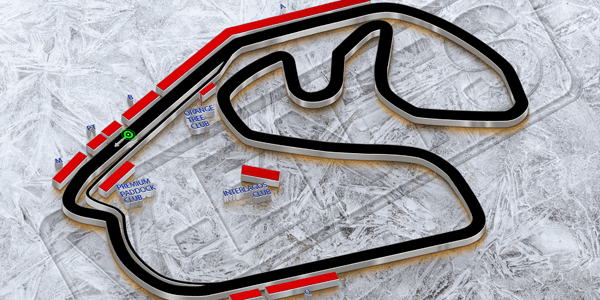
c/o Wiki ......... Autódromo José Carlos Pace, also known as Interlagos, is a motorsport circuit located in the city of São Paulo, in the neighborhood of Interlagos. It is named after Brazilian Formula One driver Carlos Pace, who died in a plane crash in 1977. It has hosted the Formula One Brazilian Grand Prix since 1973.
The Brazilian Grand Prix has always been more of a promoter event than a profit-raiser in itself. The contract was prolonged until 2022, although tobacco advertising has been banned since 2006.
The circuit is one of a minority of non-oval racing circuits to go in an anti-clockwise direction (Circuit of the Americas, Imola, Istanbul Park, Yas Marina Circuit, Laguna Seca, Singapore, Korea International Circuit, Phillip Island Grand Prix Circuit, and Circuit Ricardo Tormo in Valencia, being notable others). In 1979 upgrading work was done and the pit lane was extended past the first left-hand turn (Curva 1), making the corner more narrow, and the pit lane ended right in the middle of Curva 1 and 2. The present design of the track dates back to 1990, when the original circuit was shortened from 7.87385 km to 4.325 km. As a consequence of the reduction, the track lost three long straight sections and nine fast curves (5 were lost forever, 4 were made slower and are still there). The original track was full of fast corners and it allowed cars to keep maximum speed for up to twenty seconds[citation needed] and was considered very dangerous (although no one ever died there whilst racing Formula One) and in 1990 the old layout was majorly revised. The new track still had a very long top-speed section that contained bumps, high-speed turns and little run-off area (though the track was very wide at this point).
One reason why many drivers consider Interlagos interesting is that it was not built on flat terrain, but follows the ups and downs of hilly ground, which makes it harder to drive and demands more power from the car's engines. The hilly course is also a good feature for road cycling races usually held at the circuit.
The circuit is known for its many inclines and formerly bumpy surface, which could take its toll on F1 cars because they have a very low ride height and little suspension travel. The races are therefore very tough on the car, and also physically tough on the drivers, especially since the circuit is anti-clockwise, where the centrifugal forces in the many hard left turns push the drivers' necks to the right, instead of left as in the majority of circuits on the F1 calendar.